
Transformation Design for Experiences That Change People
Awaken Soul Station is a Transformation-Design Practice designing the systems behind transformational experiences.
We work with organisations that create, curate, source or deliver experiences designed to change people — from transformational destinations and retreat organisations to experience companies, hospitality groups and organisations creating bespoke experiences for their clients.
The practice sits at the intersection of human transformation, experience design and organisational architecture.
Transformation Can Be Designed
Human transformation is not a single event.
It unfolds through the relationship between a person, an environment, practitioners, experiences, meaning, timing, social context and what happens afterwards.
This means a transformational experience cannot be understood simply as a retreat, treatment, workshop, ceremony, programme or beautiful environment. Those may all be important components, but transformation emerges through the relationship between the components and the human being moving through them.
Awaken Soul Station begins with a different question:
What human transformation is this experience designed to facilitate, and what architecture makes that transformation possible?
This is the foundation of Transformation Design.
Why Transformation Requires Architecture
A transformational organisation can have exceptional practitioners, a compelling programme, a beautiful environment and thoughtful hospitality — and still deliver a fragmented experience.
One practitioner may not know what another has done.
Preparation may be disconnected from the central experience.
The environment may communicate something different from the programme.
The experience may end without meaningful integration.
Operations may work perfectly for the organisation while creating unnecessary friction for the person moving through the journey.
The problem is often not the quality of the individual components.
It is the architecture connecting them.
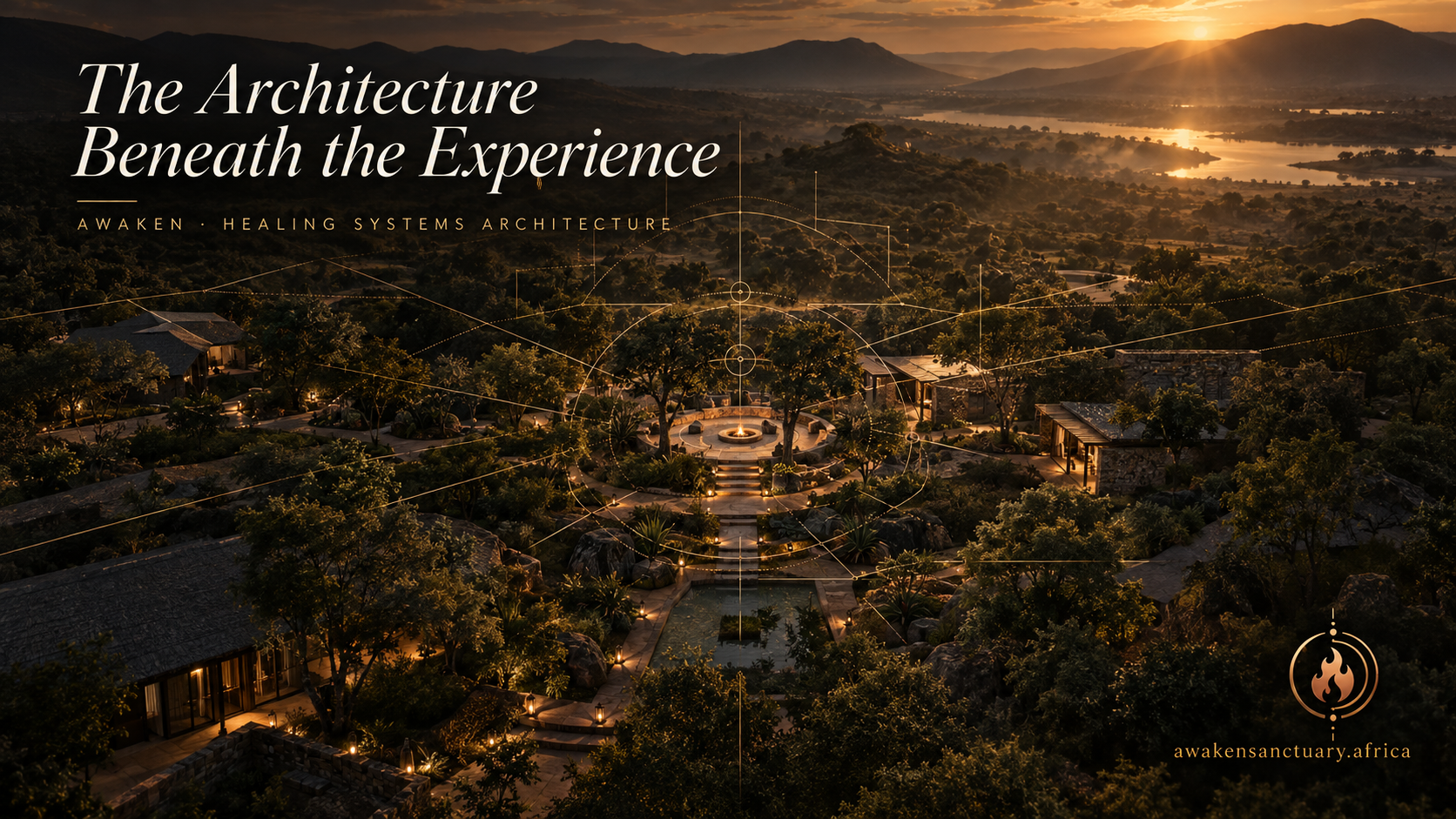
Soul Station works in that space between the parts — examining how purpose, people, practitioners, journey, environment, experience, integration and operations interact to create the whole.
What Soul Station Sees That Conventional Approaches Often Miss
A transformational organisation can have exceptional practitioners, a compelling programme, a beautiful environment and thoughtful hospitality — and still deliver a fragmented experience.
One practitioner may not know what another has done.
Preparation may be disconnected from the central experience.
The environment may communicate something different from the programme.
The experience may end without meaningful integration.
Operations may work perfectly for the organisation while creating unnecessary friction for the person moving through the journey.
The problem is often not the quality of the individual components.
It is the architecture connecting them.
Soul Station works in that space between the parts — examining how purpose, people, practitioners, journey, environment, experience, integration and operations interact to create the whole.
The Human Being Is Part of the Architecture
The person moving through a transformational experience is not a passive consumer.
They arrive with a particular level of readiness, expectation, context, agency, perception, emotional and physiological state, relationships and capacity to make meaning from what they encounter.
Transformation therefore cannot be designed solely from the organisation’s perspective.
The architecture must account for the human being moving through it.
This changes how we think about preparation, arrival, orientation, activation, experience, processing, integration and continuation.
The Organisation Is Part of the Experience
The organisation itself becomes part of the transformational journey.
Booking, communication, arrival, hospitality, practitioner interaction, programme structure, transitions and follow-up all communicate something to the person experiencing them.
Each can support the intended transformation.
Each can also fragment it.
Soul Station therefore looks beyond the central programme to the wider system surrounding it.
The experience begins before the experience begins — and it does not necessarily end when the programme ends.
Transformation Systems Architecture
The discipline beneath the practice
Transformation Systems Architecture is the design of the interconnected systems through which an organisation facilitates meaningful human transformation.
It considers the relationship between:
People
Purpose
Journey
Experience
Practitioners
Environment
Integration
Operations
The architectural question is:
What must be true, connected and intentionally designed for an organisation to deliver the transformation it promises?
This is not a universal template.
Every organisation has its own identity, audience, context, resources and transformation promise. The architecture must emerge from those realities rather than being imposed upon them.
Transformation Is a Journey, Not a Moment
A transformational experience may involve:
Intention → Preparation → Arrival → Orientation → Activation → Core Experience → Processing → Integration → Continuation
This is not a rigid universal sequence.
It is a way of asking what the human being needs at each stage and what the organisation must design around that need.
The central experience may be powerful, but what happens before it and after it can determine whether the experience feels coherent, supported and capable of being carried forward.
Integration is therefore not an optional addition to the programme.
It is part of the architecture.

Soul Station’s architectural process moves through seven movements:
Understand the organisation, its transformation promise, audience, current experience, practitioners, programmes, environments, operations and gaps.
Trace the human journey and identify touchpoints, transitions, friction and disconnection.
Clarify the intended transformation, experience philosophy, participant needs, roles, responsibilities and standards.
Design the relationships connecting journey, experience, practitioners, environment, facilitation, communication, integration and operations.
Build the human capability required to deliver the architecture.
Turn the architecture into frameworks, standards, playbooks, protocols and repeatable organisational systems.
Use experience, participant and practitioner learning to continuously refine the system.
Meet Vuyiswa Kayembe
Transformation Systems Architect & Facilitator
I understand what happens to a human being inside a transformational experience — and I know how to translate that understanding into an organisational system.
My work sits between two perspectives.
The first is the human experience itself: what happens when a person enters an intentional environment, encounters practitioners, moves through an experience and attempts to integrate what has changed.
The second is the system surrounding that experience: the organisation, journey, practitioners, environment, programme, operations and structures that determine how those elements come together.
Soul Station exists at the intersection of those two perspectives.
The practice is therefore not simply about designing better programmes.
It is about understanding what the experience is trying to make possible for a human being — and designing the organisational architecture capable of supporting that intention.
The Sanctuary Is the Laboratory | Soul Station Is the Architecture Practice
Awaken Sanctuary for Awareness is the direct-human-transformation arm of the wider Awaken ecosystem.
It provides a functioning environment in which transformation is experienced, observed, understood, refined and translated into architecture.
This matters because Soul Station does not approach transformation solely as an abstract organisational concept.
Direct engagement with people provides an experiential reference point for understanding what happens inside transformational environments — how practitioners influence the journey, where experiences become coherent or fragmented, what happens before and after the central experience, and what organisations need to design intentionally.
But the Sanctuary is not the answer for every Soul Station client.
Soul Station can work with an organisation’s existing destination, external practitioners, another retreat centre, hospitality environment, experience company or other appropriate resources.
The principle is simple:
Design the right solution for the client.
