

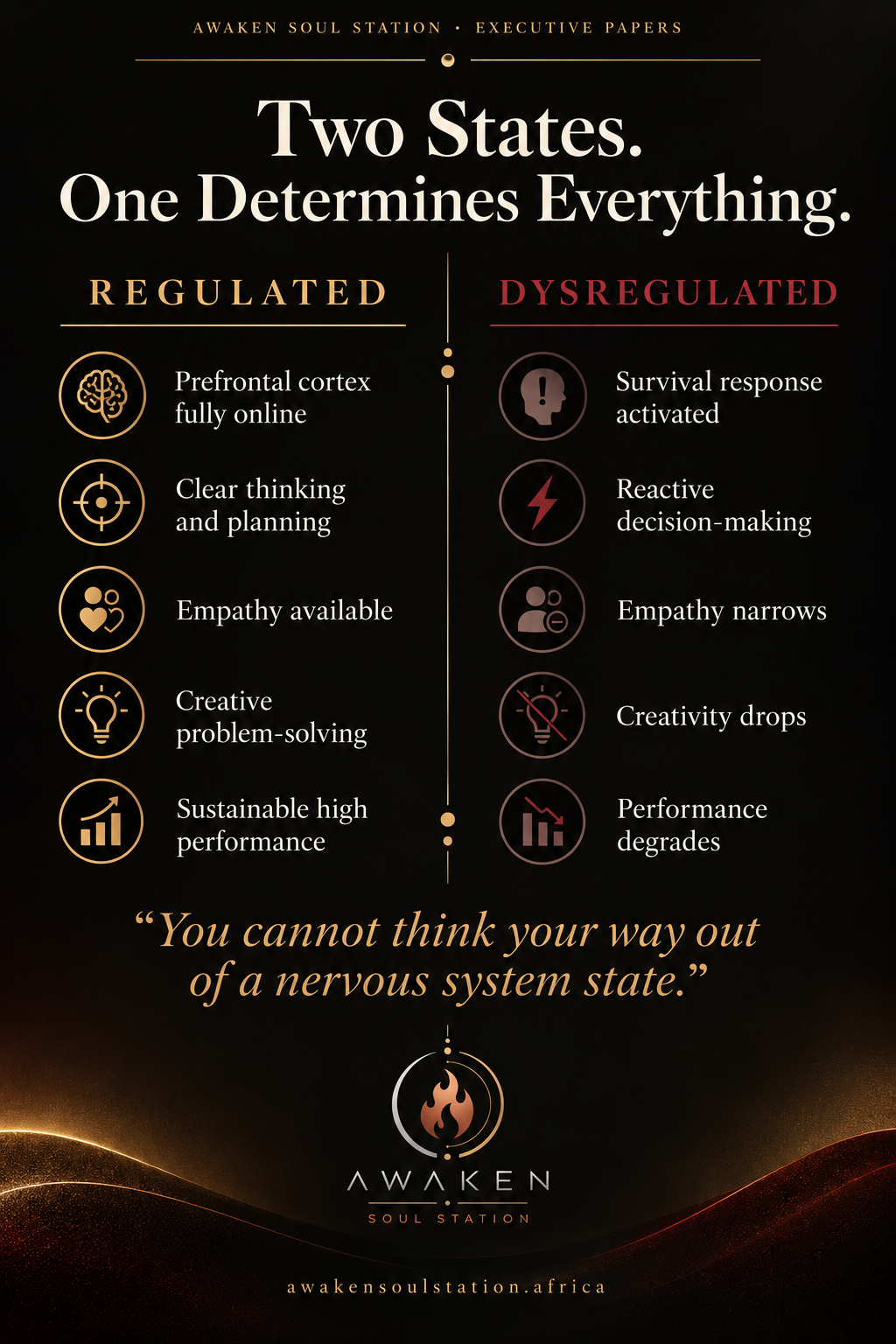
Here is what most organisations do not realise: chronic stress, unresolved conflict, unclear expectations, poor leadership behaviour, and cultures of psychological unsafety do not simply make people uncomfortable. They keep people’s nervous systems in a state of chronic low-grade threat — which means they are operating, day after day, with a partially offline brain.
What this looks like in practice
Dysregulation does not announce itself with a diagnosis. It arrives quietly, wearing familiar costumes.
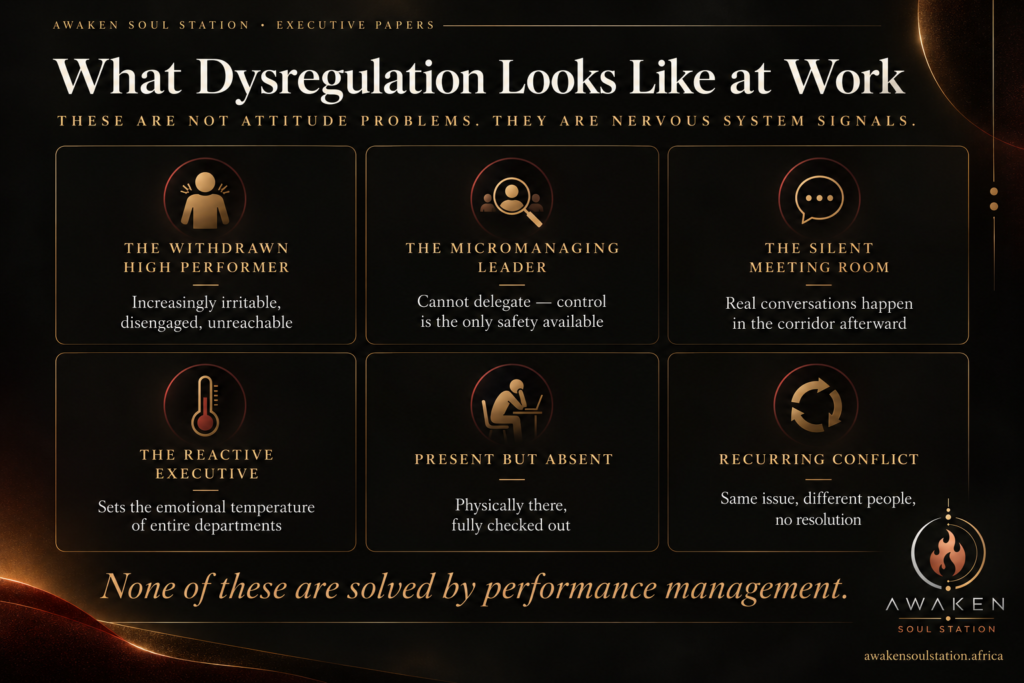
It looks like the high performer who has become increasingly irritable and withdrawn. The manager who cannot stop micromanaging no matter how many times it is addressed in supervision. The team that goes silent in meetings and saves its real conversations for the corridor afterward. The leader whose emotional reactions set the temperature of entire departments. The employee who is physically present and professionally absent.
None of these are personality problems. None of them are solved by performance management frameworks, communication training, or wellness stipends.
They are nervous system problems. And they require nervous system understanding to address effectively.
Why this matters more now than ever
The pace, complexity, and uncertainty of modern organisational life has created conditions that are genuinely hostile to nervous system regulation. Constant connectivity. Accelerating change. Increasing workloads with decreasing recovery time. Leadership demands that require emotional sophistication that most leaders were never equipped with.
The result is an epidemic of chronic dysregulation that is costing organisations in ways they have not yet learned to measure — in performance, in retention, in culture, in the quality of decisions made by people operating below their actual capacity.
The organisations that will lead in the next decade are not the ones with the best strategy documents.
They are the ones that understand what their people’s nervous systems need in order to perform at the level the strategy requires.
What becomes possible when organisations take this seriously
When leaders understand nervous system regulation — not as a wellness initiative but as organisational infrastructure — everything changes.
Conflict that was previously managed becomes genuinely resolved. Feedback that was previously avoided becomes possible. Leadership that was previously reactive becomes grounded. Cultures that were previously performative become genuinely safe.
And performance — sustainable, creative, collaborative, human performance — becomes available in ways that no framework, incentive structure, or leadership development programme could produce on its own.
This is the conversation Awaken Soul Station exists to have with organisations that are ready for it.
What to notice this week
Pay attention to the nervous system states in your organisation this week. Not the performance metrics. The actual states.
Notice what happens in the room when bad news arrives. Notice who goes quiet and who escalates. Notice the quality of thinking in high-pressure meetings versus low-pressure ones. Notice what your own body does when you receive a difficult email.
You are not looking for problems. You are beginning to learn a language — the language your organisation has been speaking all along, in a register most leaders were never taught to hear.
Three questions worth sitting with
What would change in your organisation if every leader understood the difference between a skill gap and a regulation gap?
Where in your organisation is chronic dysregulation being misread as a performance or attitude problem?
What would it cost your organisation to continue solving nervous system problems with non-nervous-system solutions?
Working with Awaken Soul Station
Awaken Soul Station works with leaders and organisations at the intersection of neuroscience, trauma-informed practice, and conscious leadership. We help organisations understand what is actually driving their performance, wellness, and culture challenges — and build the specific capacities required to address them at the root level.
If this paper has named something you have been living in your organisation without having the language for it, we would like to talk.
Visit awakensoulstation.africa to learn more about how we work.