
Why Retreat Centres That Are Genuinely Changing People Have Something Others Don't
Retreat Experience Architecture
Most retreat centres and wellness destinations have already built something remarkable.
The land has been chosen with intention. The accommodation reflects a particular vision of what restoration should feel like. The kitchen sources ingredients that honour the body. The team has been assembled from people who genuinely care. The aesthetic communicates something — a quality of attention, a seriousness about what this space is for.
And guests arrive. They experience something. They leave grateful.
But founders and directors of serious retreat centres often carry a quiet question that rarely gets asked out loud:
Is what is happening inside this space actually doing what we built it to do?
The Gap No One Names
The wellness and retreat industry has grown significantly in the past decade. There are more retreat centres, more facilitators, more modalities, and more guests than at any point in recent history. The market data suggests demand for transformational experiences is not slowing down.
And yet, underneath the growth, a gap persists — not in the quality of the environments being created, but in the coherence of what happens inside them.
Most retreat centres are operating with a programme rather than an architecture. The distinction matters more than the industry currently acknowledges.
A programme is a sequence. It places valuable elements beside one another — a morning yoga class, a sound healing session, a cacao ceremony, a breathwork experience, a workshop on nervous system regulation — and trusts that proximity will produce integration. Each element may be excellent in its own right. Each facilitator may be highly skilled and genuinely dedicated.
But excellent parts do not automatically produce a coherent whole. And coherence is what transformation actually requires.
“The spaces genuinely changing people are not the ones with the most modalities or the most facilitators. They are the ones where someone has designed the whole system — before, during and after the experience itself.”
— Vuyiswa Kayembe —
What a Transformational Architecture Actually Is
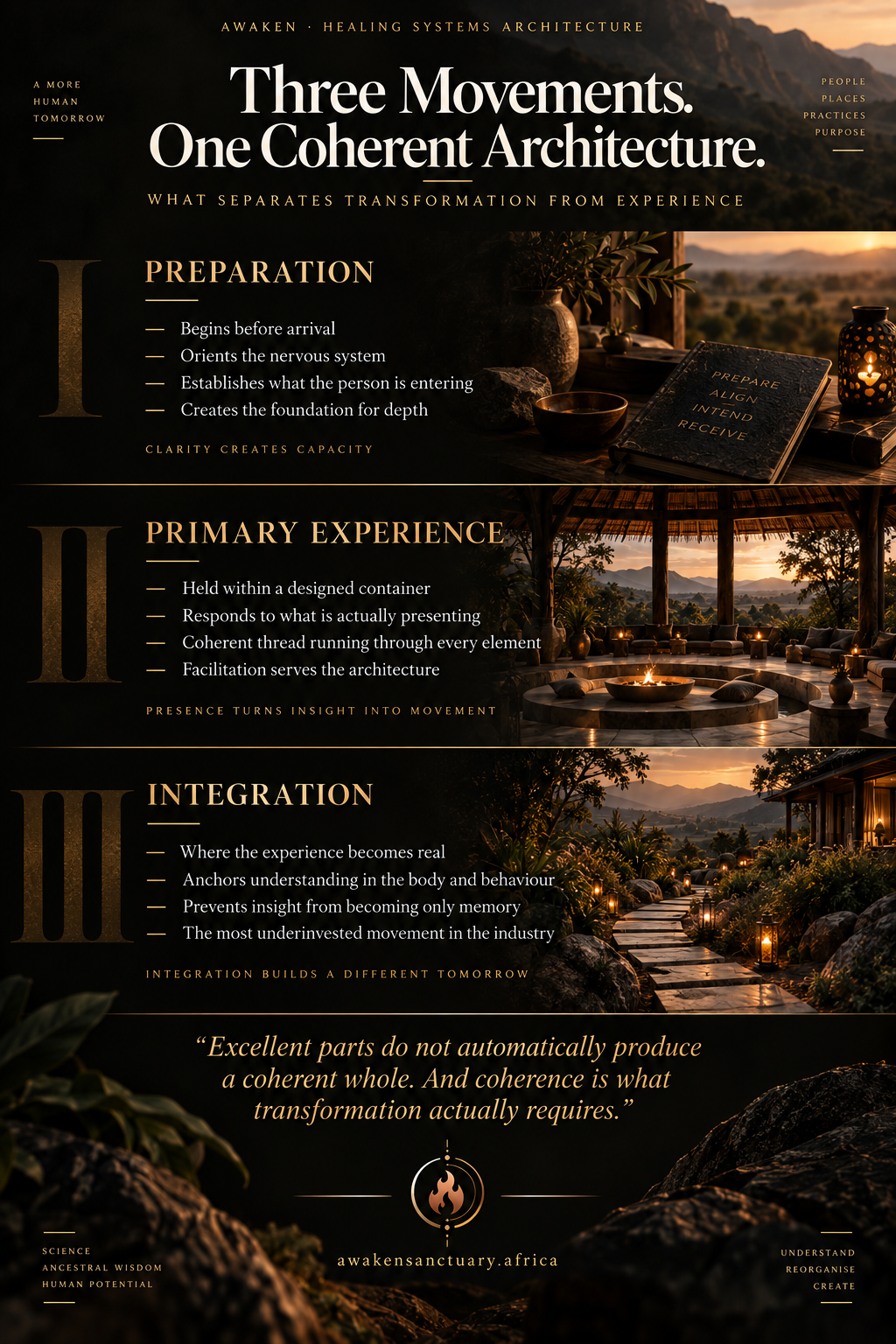
The Three Movements That Make Transformation Possible
A transformational architecture is not more complex than a programme. In some ways it is simpler — because it has a logic, a spine, a coherent intention that runs through every element of the experience.
That architecture moves through three essential movements, regardless of the environment, the modalities, or the people being served.
Preparation is the movement that most retreat programmes either skip entirely or treat as administrative onboarding. A welcome email. A packing list. Perhaps a pre-arrival call.
But preparation is actually the first transformational intervention.
The primary experience then takes place within a designed container — not a rigid itinerary that forces everyone through identical steps, but a structure that can respond to what is actually presenting itself within a coherent transformational intention.
This is where facilitation and architecture intersect. A skilled facilitator working within a coherent architecture can respond to what is emerging — can slow down where depth is calling, can move on where something has completed, can hold the unexpected without losing the thread — because the thread exists. The architecture provides the container. The facilitation responds within it.
Without the architecture, facilitation becomes improvisation. Improvisation can produce moments of genuine connection or insight. It rarely produces transformation that reorganises how someone actually lives.
Integration is the movement the retreat industry most consistently underinvests in. The experience ends. Guests depart. Perhaps there is a follow-up email or a WhatsApp group. Perhaps there is a recommended reading list.
But integration is not what happens after the retreat. It is the process through which what happened in the retreat becomes real.
The nervous system needs time and support to metabolise significant experiences. New understanding needs to be anchored in the body and in behaviour, not just in the memory of a powerful moment. The patterns that the retreat began to shift will reassert themselves the moment everyday life resumes — unless there is an architecture for integration that gives the understanding somewhere to go.
Why Sacred Plant Medicine Raises the Stakes
The Responsibility the Architecture Must Hold
There is a particular conversation the retreat industry needs to have more honestly — and it concerns the growing number of retreat centres incorporating sacred plant medicine into their offerings.
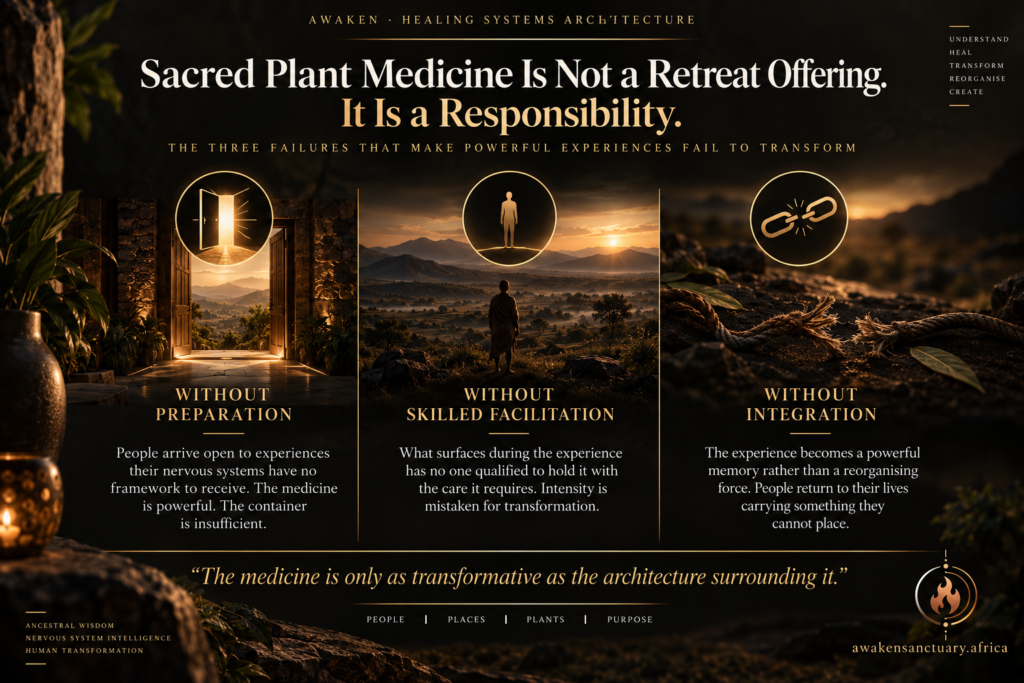
Sacred plant medicine is not a retreat activity. It is a responsibility.
The medicine opens dimensions of human experience that most people have never encountered — ancestral fields, embodied trauma, states of consciousness that bypass ordinary psychological defences and bring what has been held beneath the surface into direct contact with awareness.
That opening is only as valuable as the architecture surrounding it.
Medicine without genuine preparation means people arrive chemically open to experiences their nervous systems and psyches have no framework to receive. The experience may be intense, meaningful, even extraordinary — and leave the person more confused, more raw, and less integrated than when they arrived.
Medicine without skilled facilitation — facilitation that understands not just the ceremonial form but the depth of what can emerge — means what surfaces during the experience has no one qualified to hold it with the care it requires.
Medicine without integration architecture means the experience becomes a powerful memory rather than a reorganising force in how someone lives, relates, chooses and creates.
The retreat centres doing this work responsibly are not the ones with the most dramatic testimonials. They are the ones who understand that the medicine is only as transformative as the architecture surrounding it — and who have invested in building that architecture rather than simply adding medicine to a programme.
What the Architecture Makes Possible
The Difference Guests Can Feel and Owners Can See
When a retreat space is held within a coherent transformational architecture, several things change — not just for guests, but for the retreat centre itself.
Guests arrive oriented rather than disoriented. They enter the experience knowing what they are here for, even if they cannot fully articulate it yet. Their nervous systems begin to shift before the first session starts.
The experience itself has a quality of coherence that guests can feel even when they cannot name it. Things connect. Insights land somewhere. The sequence feels designed rather than assembled. There is a thread running through the days that builds rather than resets.
After departure, guests carry something they can point to — not just a feeling of having been away, but an understanding of what changed and what they are returning to their lives with. They refer other people not because the accommodation was beautiful but because something genuinely shifted.
For the retreat centre, the architecture produces a different quality of client relationship. Guests become advocates because the experience delivered on something real. Repeat bookings happen not out of loyalty to a beautiful space but out of genuine desire to go deeper. The centre develops a reputation — specific, differentiated, hard to replicate — for a particular quality of transformation that its environment and its architecture together produce.
That reputation is not built by marketing. It is built by what actually happens inside the space.
Three Questions Worth Sitting With
If you are a retreat centre owner, director or wellness destination developer, these questions are worth genuine reflection:
If you removed the aesthetic, the accommodation, and the natural environment from your guest experience — what would remain? Is there a coherent transformational architecture that would still hold the experience together?
What does your integration support actually look like — and is it genuinely designed to help guests metabolise and apply what happened, or is it more of a courtesy gesture at the end of a programme?
If you are offering sacred plant medicine or planning to — who has designed the preparation, facilitation and integration architecture? And are they genuinely qualified not just to facilitate a ceremony but to hold the full depth of what the medicine can open?
What to Notice This Week
Pay attention to how guests talk about their experience — not in the immediate glow of departure, but in the language they use when they describe it to others. Are they describing what they felt? Or are they describing what changed?
That distinction is one of the clearest signals of whether a retreat programme is producing an experience or producing transformation.
Working With Awaken
Awaken works with retreat centres, wellness destinations and practitioners as a Transformation Systems Architect and Facilitator — designing and facilitating the transformational architecture that sits inside an existing environment.
The host provides the space, the accommodation, the operational infrastructure and the guest relationship. Awaken provides the architecture that makes the space genuinely transformational.
This is not retreat facilitation as it is usually understood. It is the design of the whole system — preparation, experience and integration — built around the specific people, purpose and environment of each commission.
If what this paper has described is the gap you have been feeling in your own retreat centre or wellness destination, the right next step is a conversation.
Commission enquiries: https://awakensanctuary.africa/program/retreat-design-and-facilitation/
About the Author
Vuyiswa Kayembe is a Transformation Systems Architect, Facilitator and Educator working at the intersection of human transformation, consciousness and systems.
She is the founder of Awaken Sanctuary for Awareness — a private transformational practice and physical sanctuary on 8.5 hectares of sacred land in South Africa — and Awaken Soul Station, which brings the same intelligence into leadership, organisations and conscious enterprise.
Her approach, Human Transformation Intelligence, draws on neuroscience, psychology, somatic practice, ancestral wisdom, spiritual intelligence, nature, sacred plant intelligence and experiential design — not as separate techniques but as one integrated transformational architecture expressed differently according to the people and environment being served.
Vuyiswa works with retreat centres and wellness destinations as the person who designs and facilitates the whole transformational system — not as a guest facilitator, but as the architect of the experience itself.
Commission enquiries:
https://awakensanctuary.africa/program/retreat-design-and-facilitation/